Why Your Relationship With Food, Drink, and Exercise Isn't Calm
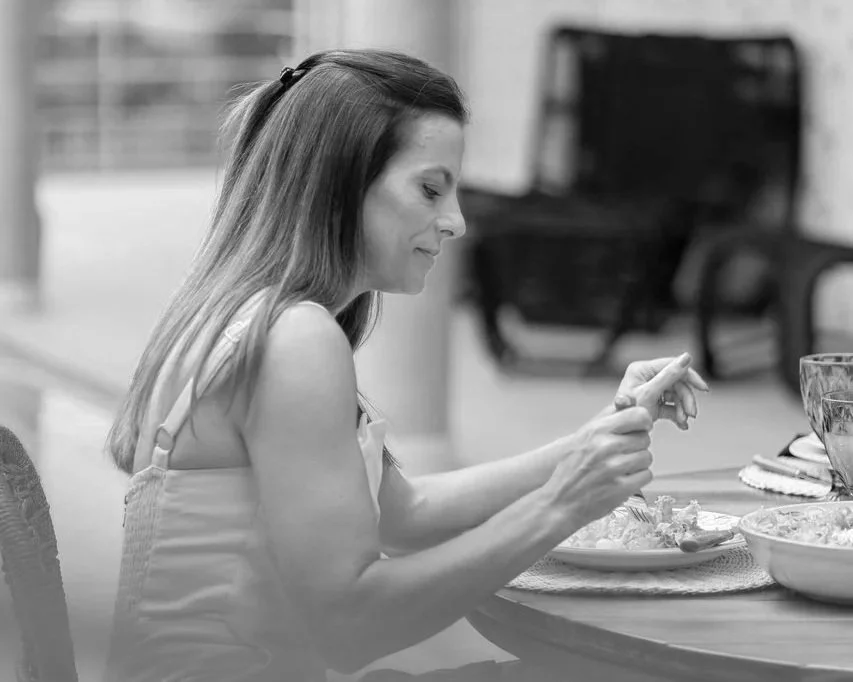
You know what's good for you. You've read enough, tried enough, started enough times to know exactly what you're "supposed" to do.
And still — the gym session gets skipped. The extra glass gets poured. The packet of biscuits disappears faster than you intended once the first one's gone.
If your instinct is to call this a discipline problem, I want to offer a different way of looking at it. Because in my experience, almost none of this is really about willpower at all.
Emotional eating
Food is rarely just food. For many women, it's comfort when something feels too much. A reward when nothing else has felt good in a while. A way to numb a feeling that hasn't been processed. Or, quietly, a form of punishment — eating in a way you'll later criticise yourself for, almost as if some part of you believes that's what you deserve.
None of this began as a conscious decision. Somewhere — often early — food became associated with safety, soothing, or relief in a way nothing else quite matched. That association doesn't politely wait outside when you're trying to "eat better." It's often the very thing driving the behaviour you're trying to change.
Exercise resistance
You know exercise helps. You feel better when you do it. And still, getting there can feel like wading through wet sand.
Underneath that resistance, there's often a quieter belief at work — about your body, about whether you deserve care, or about whether you're even allowed to take up the space that exercise asks you to take up. For some women, movement was once tied to criticism, comparison, or punishment rather than enjoyment, and the body remembers that association long after the conscious mind has moved on.
The evening glass
It often starts so innocently. A glass of wine to mark the end of the day. And somewhere along the way, it becomes load-bearing — quietly holding up the transition from work to rest, from stress to calm, from "on" to "off."
The question worth asking honestly isn't really about the wine. It's: what is this actually doing for me, and what would I need instead if it wasn't there? Often the answer is something the glass was never really capable of giving in the first place — proper rest, real winding down, a nervous system that knows how to settle without help.
All-or-nothing thinking
One biscuit becomes the whole packet. One missed gym session becomes a month off. If this is familiar, it's worth knowing this isn't really about the biscuit or the missed session at all.
It's perfectionism, and perfectionism doesn't deal well with "good enough." If the plan wasn't followed perfectly, the subconscious often concludes the whole effort has failed — so why not abandon it entirely? This is a thinking pattern, not evidence of a lack of discipline, and it tends to trace back to a belief that anything less than perfect isn't worth doing, or worse, makes you a failure.
Health as punishment vs. health as care
Here's the distinction underneath everything above, and it's the one that changes the most.
Doing something to "fix" yourself comes from a belief that something about you is currently wrong, lacking, or unacceptable. Doing something because you value yourself comes from an entirely different place — not "I need to fix this body," but "I want to look after this body, because it's mine and it matters."
These can look identical from the outside — the same gym class, the same meal — but they feel completely different to sustain, because one is rooted in self-rejection and the other in self-respect. Punishment-based motivation tends to collapse the moment things get hard, because there was never any care underneath it to begin with. Care-based motivation tends to hold, because it isn't contingent on getting it perfect.
Where the real change happens
None of these patterns respond well to more willpower, because none of them were ever really about willpower. They're each, in their own way, pointing back to a belief formed somewhere — about safety, about worth, about what you deserve, about whether you're allowed to simply be well rather than constantly working to become acceptable.
This is exactly the work RTT hypnotherapy is suited to. We go back to where each of these associations first formed, and we help your subconscious update what it concluded — so that food, movement, and rest can simply be food, movement, and rest again, rather than coping mechanisms standing in for something else entirely.
You don't need more discipline. You need the belief underneath the behaviour to change. Once it does, the behaviour usually follows far more easily than anyone expects.
To learn more about how RTT Hypnotherapy can support your health and lifestyle habits visit my page here
Maria x

I’m Maria — a Clinical RTT Hypnotherapist and Confidence Coach working online with professional women worldwide. I combine Rapid Transformational Therapy with trauma-informed coaching and nervous system regulation, going directly to the subconscious root of self-doubt, anxiety and the patterns that keep brilliant women stuck.
If something in this post resonated, a first call is a relaxed, no-obligation conversation about where you are and whether this work is the right fit.
















If peaceful sleep feels out of reach, you're far from alone. Discover why an overactive mind at bedtime isn't a flaw, what's really keeping your nervous system on alert, and the practical steps — including how RTT hypnotherapy can help — that make it possible to finally switch off